
The answer? Electricity.
Meet Isaac Pulvermacher's galvanic chain.

Victorians loved to shock themselves. For a time, doctors, scientists, and charlatans alike encouraged people to try a range of electric therapies to cure everything from migraines to anxiety to edema. Electricity: the answer for whatever ailed you.
One treatment sailed to the top of the charts, though.
Isaac Pulvermacher's "hydro-electric belt" was a hit across Europe, including with two of the most lauded contemporary writers, Charles Dickens and Gustave Flaubert.
What it looked like and how it was used
More formally known as Pulvermacher's galvanic chain, developed in the mid-1800s, the device looked something like a bandolier. It was meant to be worn, like a belt or a bracelet, for a period of time, around the afflicted area. It was a chain battery, charged (by the user) in a bath of vinegar before application. (Wikipedia's entry on Pulvermacher really digs into the technical specs if you want to geek out.)
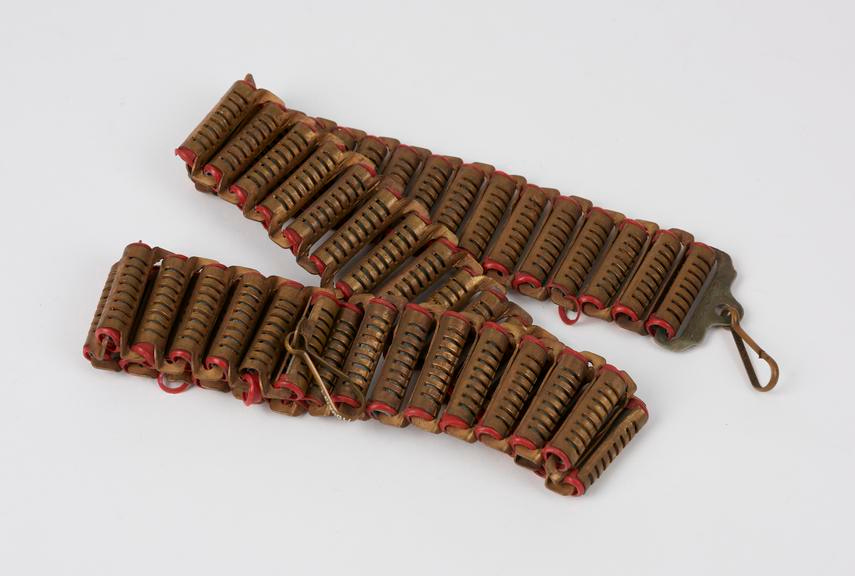
Courtesy the Wellcome Collection
A basic belt would set you back $12 dollars, a hefty sum in the late 1800s, although Pulvermacher argued that $12, spent once, was a better bargain than having to buy a continuous supply of ineffective patent medicines.
What made it different
For other treatments at the time, patients had to visit a doctor's office. Often, that treatment involved a short but intense electric shock. Pulvermacher's invention allowed users to wear the belt or chain in the comfort of their own homes. It delivered a continuous, mild current—just enough to reassure you it was working. You could wear it while you went about your business.
Breathless praise
Pulvermacher's devices came with endorsements and guarantees so effusive they would have been hard to resist, including 14 pages of doctor and patient testimonials, plus this statement from the company itself:
"...we invite any person afflicted to visit our Establishment to FREELY CONVINCE HIMSELF BEFOREHAND—leaving him to verify the assertion, 'That there has never existed a remedy so striking and immediate in its effects, so universal in its character and scope, and so simple and safe in its application.' So universal, indeed, that if an absolute panacea were possible, Electricity would be the only agent which could lay claim thereto."
-From the Pulvermacher Galvanic Company's catalog,1878
Well, sign me up.
What could the chain cure?
What couldn't it? Here's just a sample:
Rheumatism
Kidney disease
Female complaints
Paralysis
Deafness
Trembling
Pulvermacher even claimed his galvanic belt could also help with impotence if worn continuously for about 12 hours. Here’s all you need to know about that:
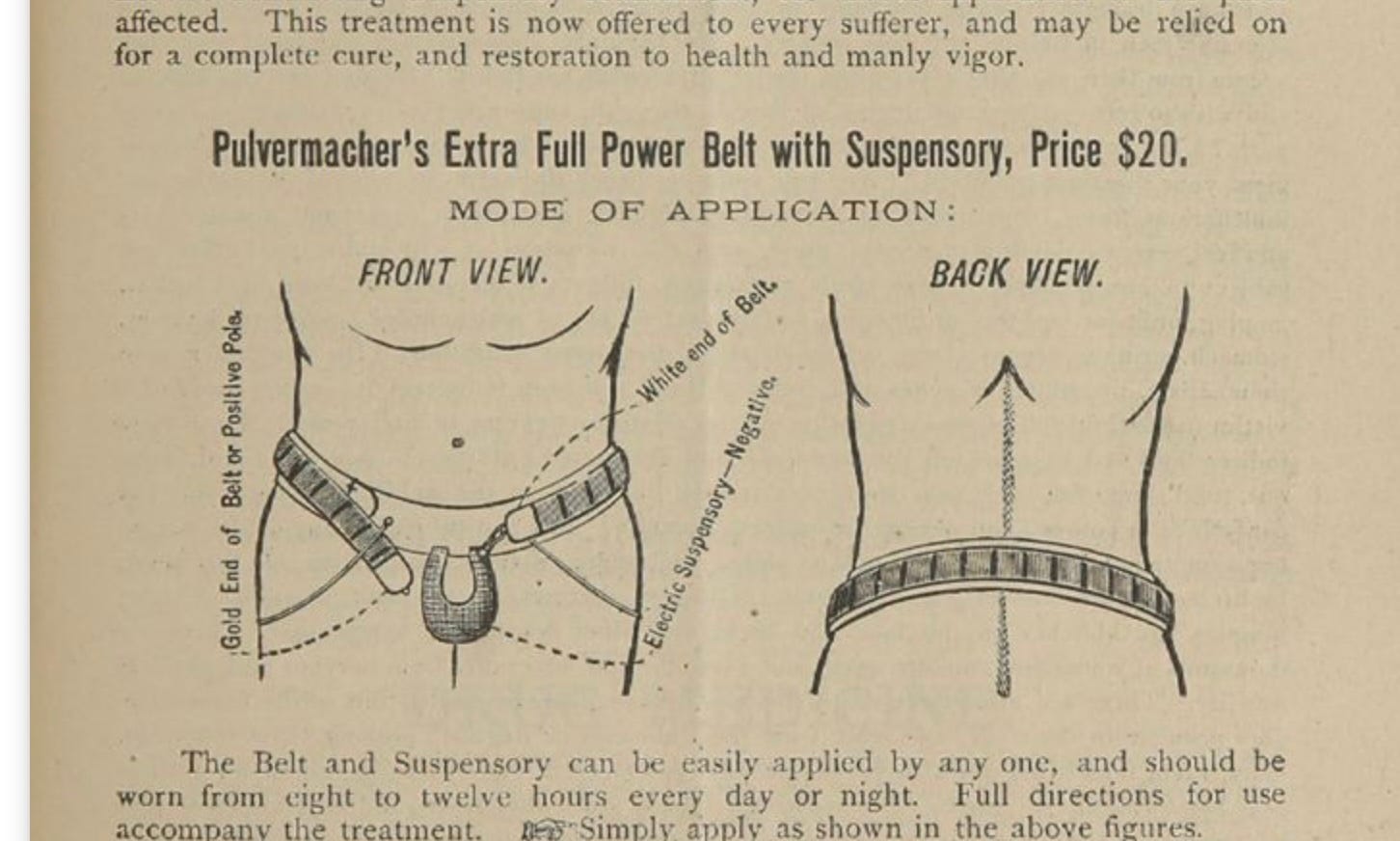
From the Pulvermacher catalog
And here’s what his devices could do for the ladies. Just look at this before and after picture for proof.

From the Pulvermacher catalog
The science behind it (at the time)
Pulvermacher's catalog put it this way:
"If we consider, on the one hand, the innumerable causes of our diseases, with the various effects they produce on the different nerves and, on the other hand, the manifold properties (physical, chemical and physiological) of Electricity, calming the sensitive nerves, reviving the nerves of movement when torpid, it is easy to see to what a multitude of diseases Electricity is applicable."
Could it work for you? Here’s your lucky chance.
If you'd like to try Pulvermacher's chain yourself, they’re going fast. I found this one on Ebay. (I receive no commission, of course... darn it.)
We're still using electricity, of course
Here's a great BBC piece, "The strange Victorian fashion of self-electrification," that puts those heady times in context. Pulvermacher and his contemporaries were not the first to see electricity as a perfect cure, and they weren't the last to see its potential. Think pacemakers. Think depression treatments. Think how far we've come and what might lie ahead.